Rocket Lab's Deep-Space Milestone: ESCAPADE Spacecraft Gold Completes Key Maneuver – A Testament to Private Innovation (Updated)
As we kick off 2026, the private space sector continues to push boundaries, and Rocket Lab stands out as a prime example of rapid progress in commercial spaceflight. Just days ago, on January 6, 2026, the Gold spacecraft – one of the twin ESCAPADE (Escape and Plasma Acceleration and Dynamics Explorers) probes built by Rocket Lab for NASA and UC Berkeley's Space Sciences Laboratory – successfully executed its second trajectory correction maneuver (TCM). This impressive 97.7 meters per second (m/s) burn, the longest yet for the spacecraft, propelled Gold past the Earth–Sun L2 Lagrange point and into its months-long deep-space cruise phase alongside its twin, Blue.
This update marks a critical step in the mission's journey to Mars, where the duo will study how the solar wind interacts with the Red Planet's magnetosphere and drives atmospheric loss – key insights for understanding planetary habitability.
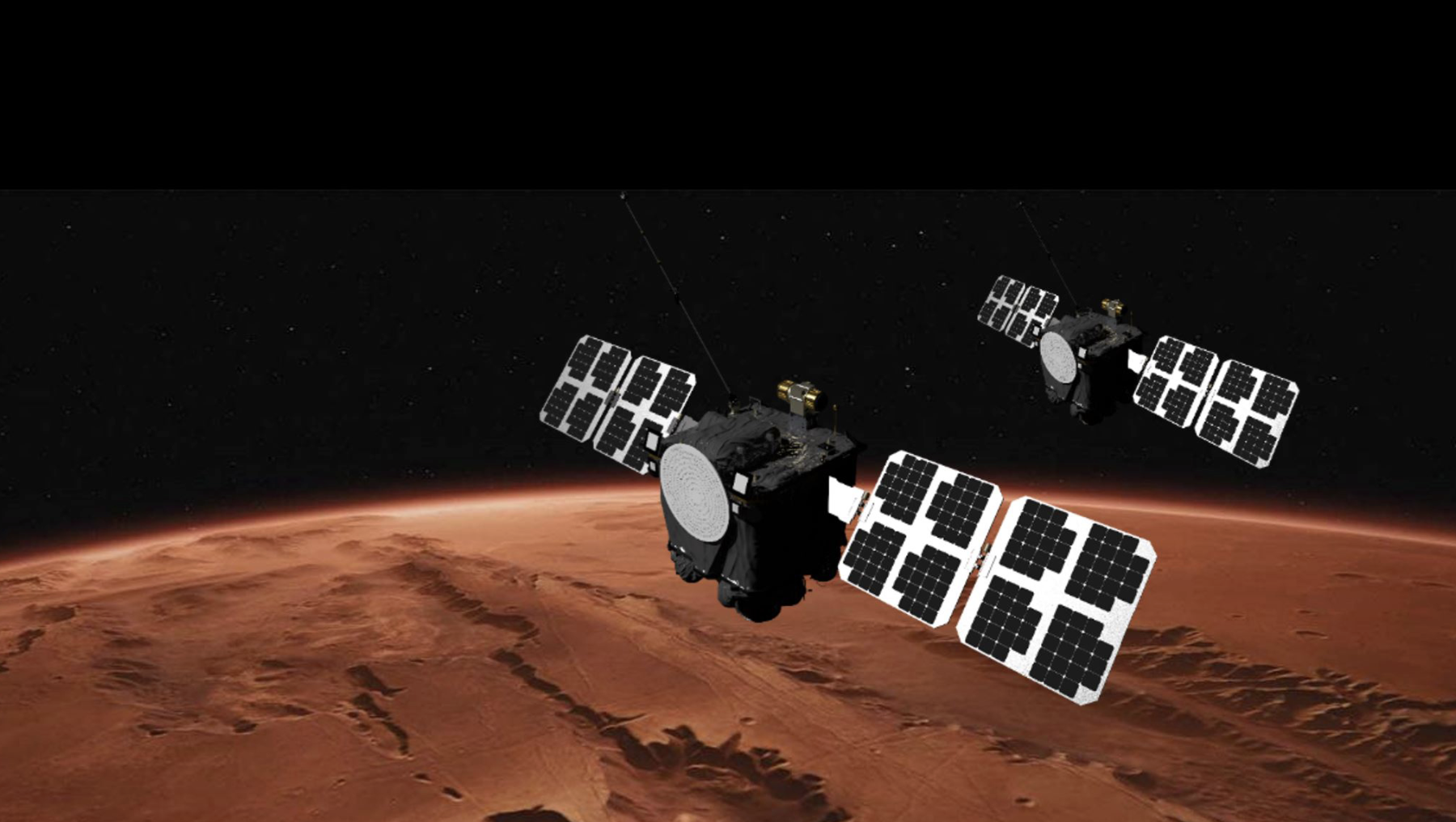
Rocket Lab's ESCAPADE mission represents a major milestone in private interplanetary exploration, with the Gold spacecraft now in deep-space cruise toward Mars.
The ESCAPADE spacecraft launched on November 13, 2025, aboard Blue Origin's New Glenn rocket. Rocket Lab designed, built, and integrated the twin Explorer-class spacecraft buses, powered by their advanced HyperCurie engines. These compact probes demonstrate Rocket Lab's evolution from a small-lift launch provider to a full-spectrum space systems company capable of delivering sophisticated interplanetary hardware.
After launch, the spacecraft entered a high "loiter" orbit around the Earth-Sun L2 point to study space weather while awaiting the optimal Mars transfer window in late 2026. The recent TCM for Gold fine-tunes their path, setting up a gravity-assist slingshot around Earth in November 2026 for the Trans-Mars Injection. Arrival at Mars is targeted for September 2027.
Rocket Lab's Remarkable Strides in Private Space
This achievement underscores Rocket Lab's remarkable progress:
- In 2025, Rocket Lab set a company record with 21 successful Electron launches, making it the second-most frequently launched U.S. rocket behind only SpaceX.
- The company has transitioned from dedicated smallsat deployments to building and operating deep-space missions like ESCAPADE – its first interplanetary endeavor.
- Looking ahead, 2026 promises even more: Neutron's debut, major U.S. Space Force contracts, and expanded global reach.
Rocket Lab's ability to deliver reliable, agile solutions highlights how private companies are democratizing access to deep space.
Why ESCAPADE is a Key Precursor to Future Mars Missions
ESCAPADE isn't just another science mission — it's designed to lay foundational groundwork for more ambitious endeavors, such as crewed landings, sustained human presence, and large-scale robotic operations on Mars. Here's how:
Understanding Space Weather and Atmospheric Protection
The mission's core goal is to study Mars' unique hybrid magnetosphere — a patchwork of crustal magnetic fields interacting with the solar wind — and the processes driving atmospheric escape (e.g., sputtering and ion escape). Over billions of years, solar wind has stripped away much of Mars' once-thick atmosphere, turning a potentially habitable world into the cold, dry desert we see today.
By using twin spacecraft for simultaneous, 3D observations (the first multi-spacecraft orbital science mission to Mars), ESCAPADE provides real-time data on how solar storms affect the planet. This knowledge is essential for protecting future astronauts and habitats from radiation and space weather disruptions, which could interfere with communications, electronics, and human health during surface operations.
ESCAPADE's data will directly inform the design of future robotic and human missions to withstand Mars' harsh space-weather conditions, as emphasized by NASA.
Pioneering Flexible, Low-Cost Trajectories for Fleet-Scale Exploration
Traditional Mars missions rely on tight ~2-year launch windows when Earth and Mars align for fuel-efficient Hohmann transfers. ESCAPADE uses an innovative "loiter" path: launching into a high orbit near Earth-Sun L2, waiting ~12 months, then using an Earth gravity assist to head to Mars. This allows launches outside optimal windows.
For future human settlement — which could require hundreds or thousands of crewed and uncrewed ships over multiple alignments — this flexibility is game-changing. Limited launch pads, weather, and delays make rigid windows impractical. ESCAPADE demonstrates how spacecraft can "queue up" in space, enabling more frequent, resilient departures. As principal investigator Rob Lillis noted, this trajectory paves the way for the massive logistical scale needed for sustained Mars presence.
Here's a conceptual view of complex interplanetary trajectories involving gravity assists (similar to ESCAPADE's approach):
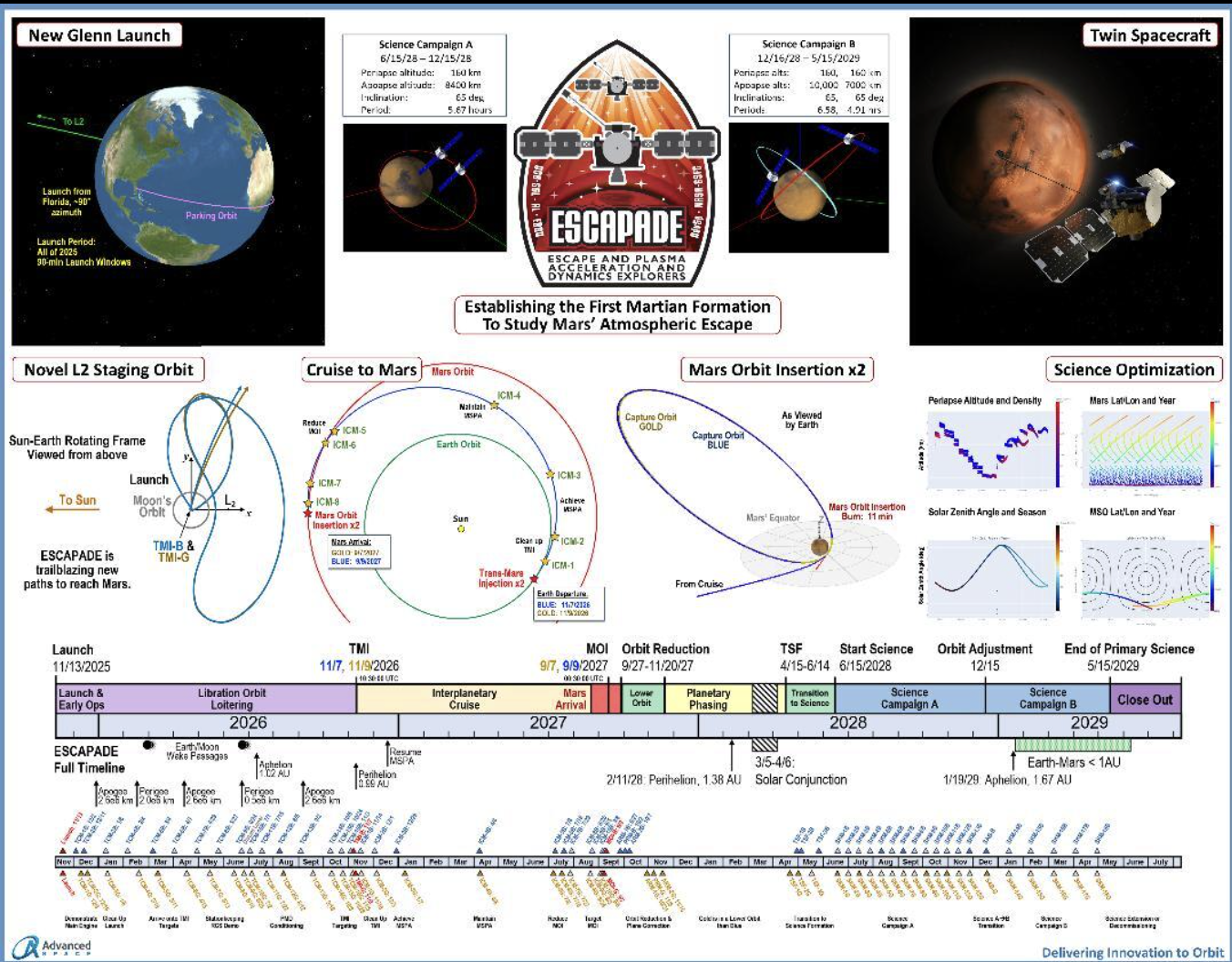
ESCAPADE's innovative trajectory: launching into a high orbit near Earth-Sun L2, waiting ~12 months, then using an Earth gravity assist to head to Mars.
Proving Private Sector Capabilities for Deep-Space Exploration
Built by Rocket Lab in just 3.5 years under NASA's SIMPLEx program (total cost ~$75 million, vs. MAVEN's $582 million), ESCAPADE showcases how commercial partners (Rocket Lab for spacecraft, Blue Origin for launch) can deliver sophisticated interplanetary hardware affordably and quickly.
This model reduces barriers, accelerates iteration, and enables more frequent precursor missions — vital for risk reduction before crewed flights or sample-return efforts.
Recent Developments: Neutron Testing and Challenges
While ESCAPADE continues its successful journey to Mars, Rocket Lab has faced a significant setback with its next-generation Neutron rocket. On January 21, 2026, during a structural test at Rocket Lab's facility, a Neutron first-stage fuel tank suffered a rupture. The test was intentionally designed to push the stage to its structural limits to validate safety margins, but the tank failure was not anticipated.
Rocket Lab CEO Peter Beck has described Neutron as a "2050 rocket" – a medium-lift vehicle designed to compete with SpaceX's Falcon 9 in terms of payload capacity (up to 28,700 pounds to low Earth orbit) and partial reusability. The 141-foot-tall (43 meters) rocket, powered by Rocket Lab's Archimedes engines, represents a major step up from the company's Electron workhorse.
The fuel tank rupture is a significant setback for Neutron's development timeline. The rocket's debut launch, originally hoped for by the end of 2025 and then pushed to Q1 2026, now appears unlikely to meet that target. Rocket Lab stated that no serious damage was caused to facilities or surrounding test structures, and the company is reviewing test data to determine a new timeline. The next stage 1 tank is already in production, and Rocket Lab plans to provide an update on the Neutron schedule during its Q4 2025 earnings call in February 2026.
This incident highlights the challenges inherent in developing new rocket systems, even for experienced companies like Rocket Lab. Structural testing to failure is a standard practice in aerospace engineering to validate design margins, but unexpected failures during these tests can reveal design issues that require iteration. Rocket Lab's transparency about the incident and its commitment to continuing development demonstrates the company's resilience and engineering rigor.
Despite this setback, Rocket Lab's broader portfolio remains strong: the Electron rocket continues its reliable launch cadence, ESCAPADE demonstrates the company's interplanetary capabilities, and major U.S. Space Force contracts provide a solid foundation for future growth.
Stay tuned to SpaceLaunchIndex.com for live countdowns, historical trackers, and the latest on private launches. Rocket Lab's progress isn't just impressive – it's accelerating the future of exploration, even as it navigates the inevitable challenges of developing cutting-edge space technology.
For more on the ESCAPADE update, check the original post: Rocket Lab Blog.
What do you think this means for the future of private Mars missions? Share your thoughts below! 🚀